
The Leadership Blind Spot in India's Semiconductor Story
India’s semiconductor journey is accelerating. Government incentives flow, investments multiply, global partnerships deepen. But a question persists beneath the momentum: Are we building this future with the full breadth of India’s talent?
ABC Consultants’ research team analyzed 17,510 senior technical professionals across India’s fabless semiconductor sector to understand where diversity stands today and where critical pathways narrow.
The Foundation: Strong Mid-Level, Thinning Senior Ranks
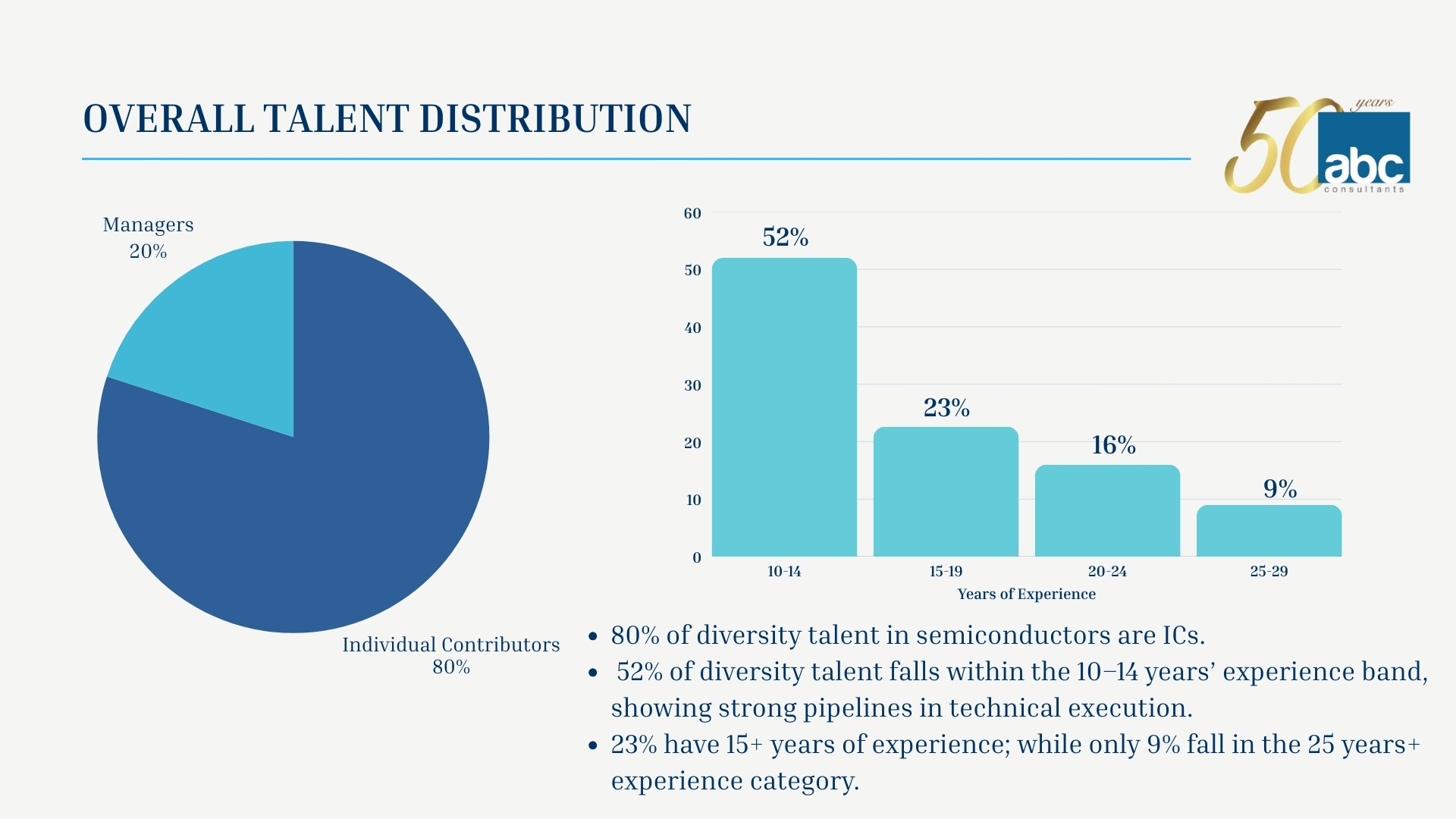
80% of diversity talent are Individual Contributors
20% are Managers
The semiconductor sector shows robust diverse talent in technical roles, with 52% concentrated in the 10-14 years experience band, precisely where deep technical expertise develops. This is India’s execution strength, the engineers crafting RTL designs and debugging complex verification scenarios.
But watch what happens at senior levels. Only 9% of diverse talent reaches 25-29 years of experience. This isn’t natural attrition. It’s a signal of pathways that narrow when they should widen.
Individual Contributors: Where Technical Talent Concentrates
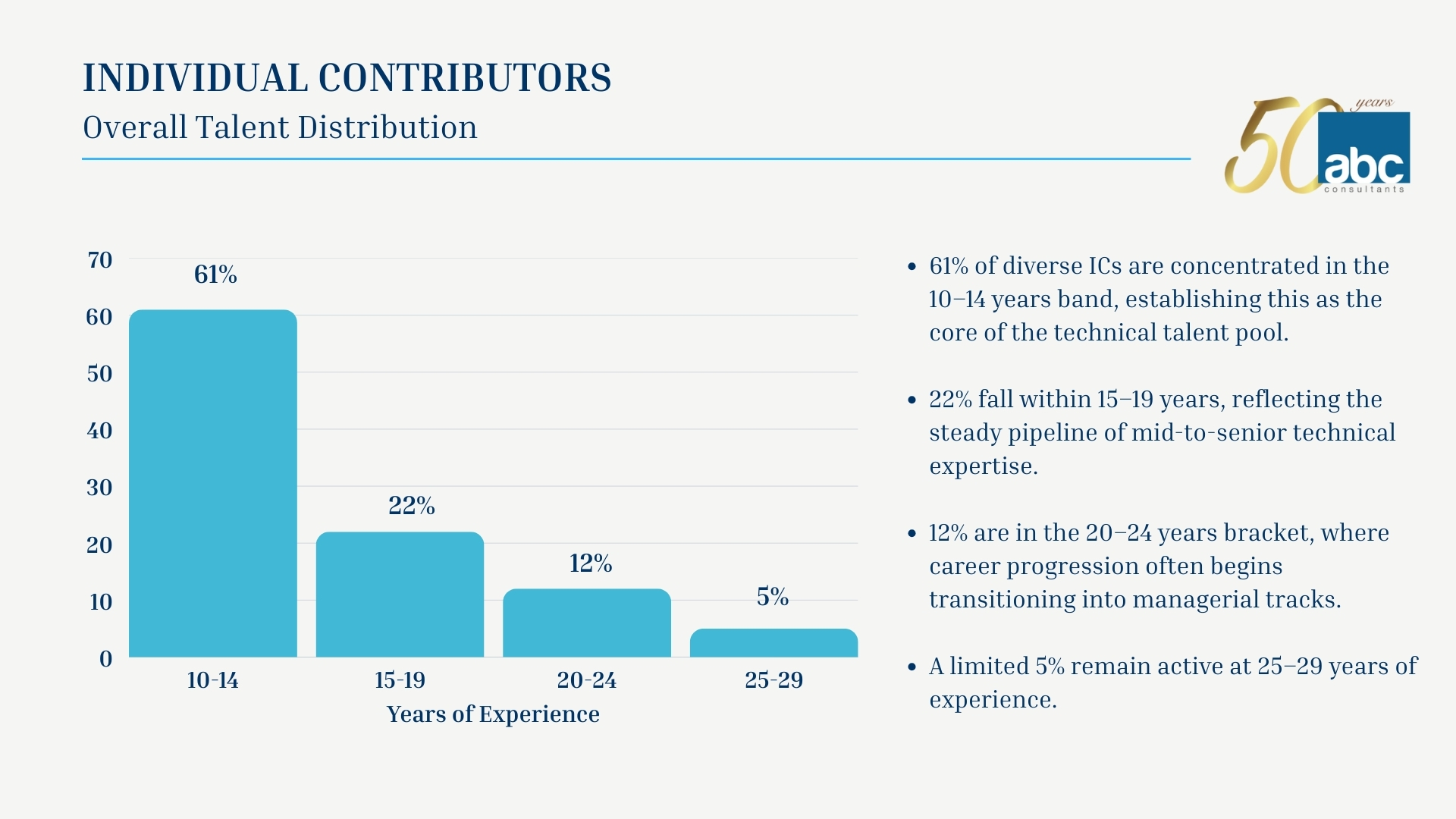
61% cluster in 10-14 years—the core technical talent pool
22% reach 15-19 years—steady mid-senior expertise
12% achieve 20-24 years—career transition zone
5% remain active at 25-29 years
The Skill Story
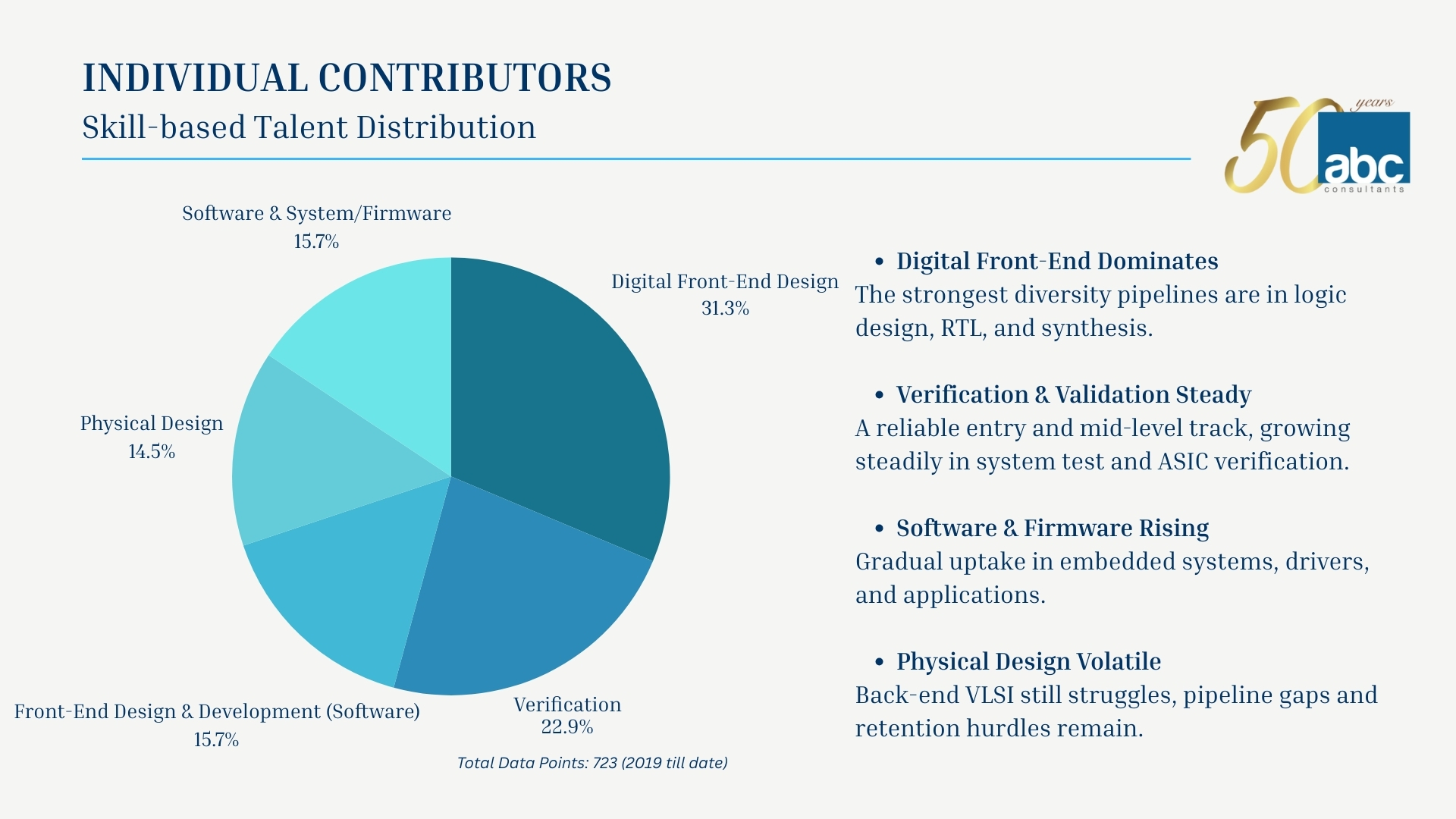
Digital Front-End Design dominates at 31.3%—logic design, RTL, and synthesis show the strongest diversity pipelines.
Verification holds steady at 22.9%—a reliable entry and growth track through system test and ASIC verification.
Software & Firmware rising at 15.7%—gradual uptake in embedded systems, drivers, and applications as semiconductor work shifts toward software-defined solutions.
Physical Design struggles at 14.5%—back-end VLSI continues to face pipeline gaps and retention challenges.
Managers: A Different Distribution Pattern
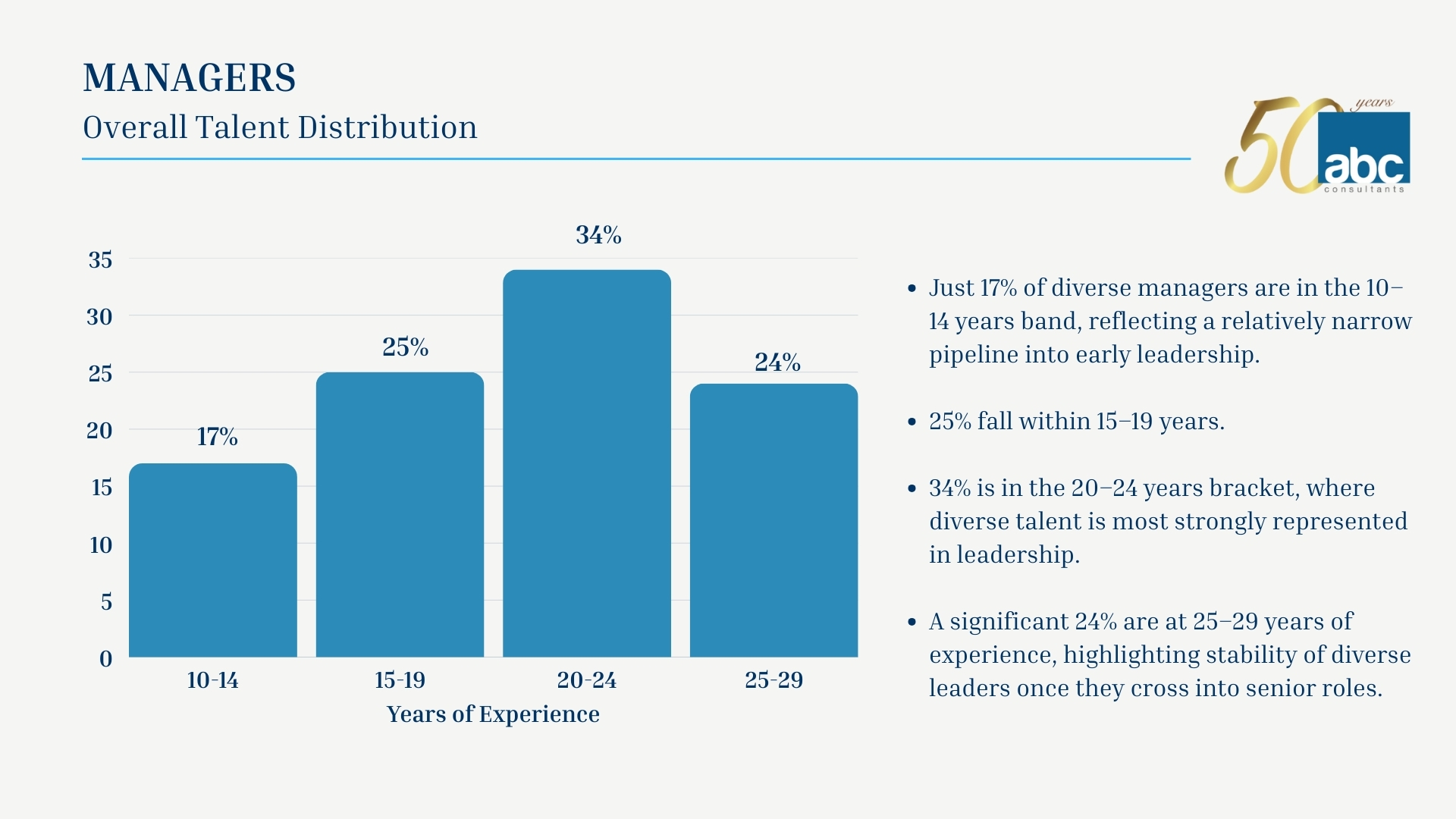
The contrast is striking. While 61% of diverse ICs sit in the 10-14 year band, only 17% of diverse managers occupy that same experience level. The leadership transition that typically begins around year 12-15 shows significant friction.
Where Diverse Leaders Concentrate
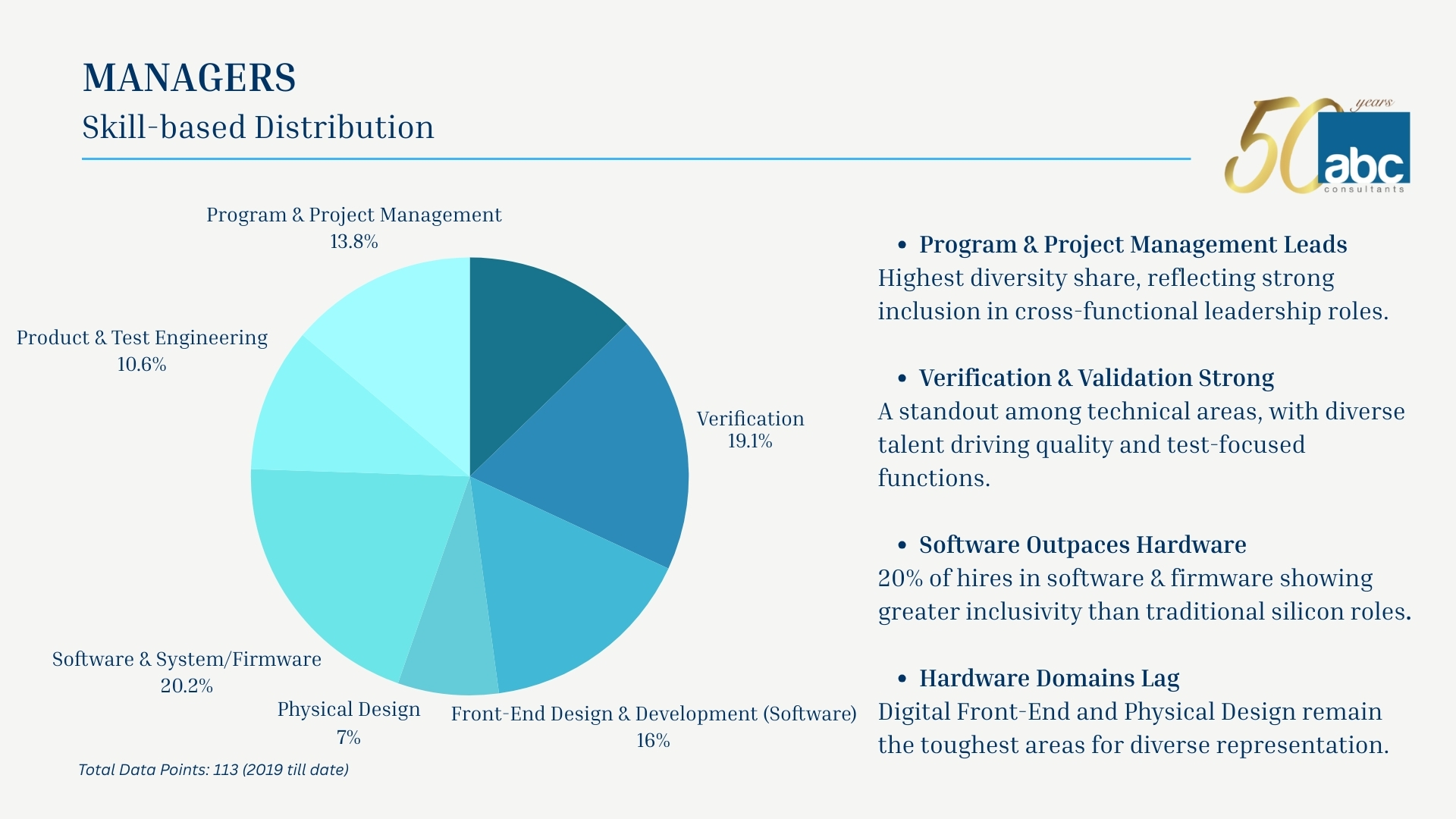
Program & Project Management leads at 13.8%—cross-functional roles show strongest inclusion, valuing collaborative skills and diverse perspectives as operational assets.
Verification remains strong at 19.1%—quality-critical functions continue translating IC strength into managerial presence.
Software outpaces hardware at 20.2%—showing greater inclusivity than traditional silicon roles.
Hardware domains lag significantly—Digital Front-End and Physical Design struggle to convert strong IC pipelines into leadership representation. Physical Design shows just 7% of diverse managers despite being critical to semiconductor success.
The Year 15 Inflection Point
The data reveals a critical transition gap. Strong diverse talent exists in mid-level technical roles. But the pathway from technical expertise to technical leadership—the transition that typically occurs between 12-15 years of experience—shows dramatic narrowing.
This isn’t about capability. We’ve placed brilliant diverse engineers who navigate this transition successfully. It’s about whether organizations actively create visible, accessible leadership pathways or whether diverse talent must navigate despite structural barriers.
A verification manager recently observed: “I didn’t see people who looked like me in leadership for twelve years. I had to imagine myself there without evidence it was possible. That requires a particular determination we shouldn’t demand of people.”
What Success Teaches Us
The domains where diversity succeeds in management share common traits. Program Management, Verification, and Software roles all value collaborative skills, cross-functional thinking, and diverse perspectives as operational necessities—not just ethical aspirations.
These aren’t “softer” roles. They’re positions where heterogeneity of thought directly impacts outcomes. Managing global programs, driving quality across complex systems, architecting software-hardware interfaces—these challenges benefit from diverse approaches.
The question for hardware-heavy domains: What can be learned from where inclusion already drives results?
The Leadership Imperative
India’s semiconductor ambitions are no longer theoretical. The ecosystem is forming, investments are flowing, talent is returning. The technical capability exists.
What remains is the organizational architecture question: Will we design pathways that unlock the full breadth of India’s talent, or will unconscious barriers limit what we build?
The data offers clear guidance:
Retain and elevate diverse ICs into leadership roles—your strongest pipeline sits in the 10-14 year band. The leadership transition mechanism determines whether they stay and grow or leave and contribute elsewhere.
Unlock inclusion in hardware-heavy domains—Digital Front-End and Physical Design must translate IC strength into managerial pathways. The technical talent exists; the transition support apparently doesn’t.
Champion diversity as operational advantage—the domains where it succeeds prove it drives innovation, resilience, and competitive performance. This isn’t compliance; it’s capability.
The Question Before Us
India’s semiconductor sector has built strong mid-level diversity pipelines. The foundation exists. What happens next depends on how quickly organizations embed diversity as a core driver of innovation and long-term competitiveness.
The question is no longer whether diversity matters. It’s how deliberately we design for it—in career pathways, sponsorship models, leadership visibility, and organizational culture.
The semiconductor story is India’s next big industrial bet. The question is whether we build it with all of India’s talent, or settle for less than our potential.
Key Research Findings:
- 17,510 professionals analyzed across India’s fabless semiconductor sector
- 80% IC / 20% Manager split reveals concentration at execution levels
- 52% of diverse talent in 10-14 years band shows strong technical pipeline
- Year 15 transition emerges as critical inflection point for leadership pathways
- Program Management, Verification, and Software show strongest diverse leadership
- Physical Design and traditional hardware roles face persistent inclusion challenges